
Skin vs. the Unseen: Godna, Sheen Kāl, and the Geometry of Protection
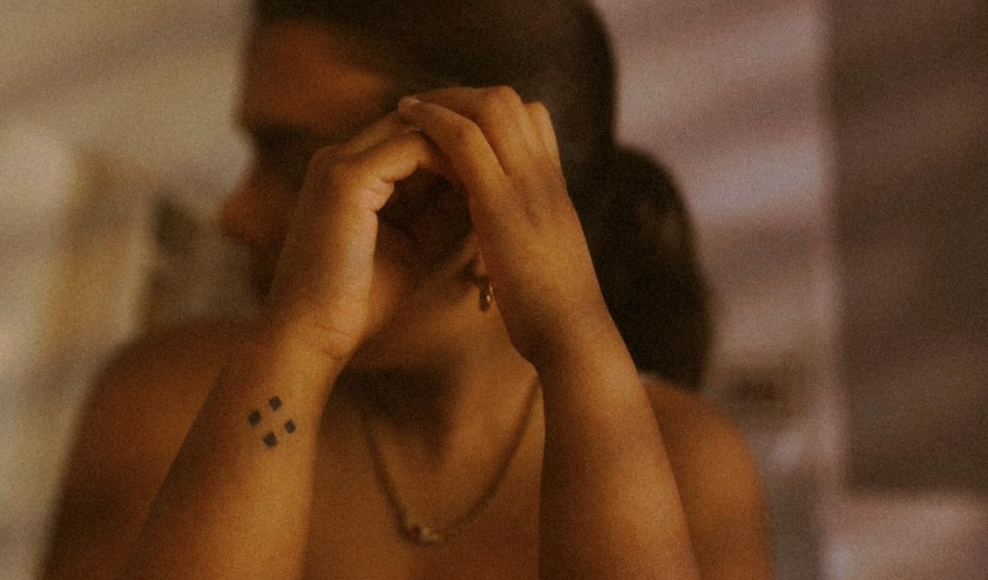
In the nineteenth century, British ships launched from the ports of modern-day Kolkata to human traffic Indian laborers to Caribbean, Fijian and Mauritian rice and sugarcane plantations. The jahajees of the Caribbean and the girmitya of Fiji and Mauritius arrived at their indentureship with very little in the way of personal possessions. Glass bangles, ganja seeds, small ornaments, and modest sarees and dhotis account for much of what crossed the kala pani (dark waters) on a voyage for which they were promised a return trip that never came to fruition.
Everything else they carried with them? Intangibles. Prayers, wedding songs, memorized recipes, and language that would eventually be thinned to film. Another possession that is often overlooked in jahajee and girmitya history, however, are the tattoos with which they crossed the kala pani and continued to practice throughout decades of indentureship, primarily among women.
Modern understandings of tattoos, by both form and function, are meant to be seen. They are theatrical and bold and shout their statement from the microphone of the epidermis. There exists another category of tattoos, however, that are meant to see for you. They are simple and unobtrusive and modest; the perfect combination for a thing that is meant to be watchful and protective.
Across continents that never shared borders (but often shared similar shapes of empire, migration, and grief) people punctured pigments into their skin not in the pursuit of beauty, but in the pursuit of armory and becoming difficult to harm. Unlike tattoos that serve as declarations of identity or aesthetics, godna and sheen kāl tattoos function as negotiations with invisible forces.
This is the story of those marks.
**********
I never thought I would get tattooed. Like, not in a million years. There was no better high than someone asking me at some overpriced Manhattan cocktail party when folks are showing their ink, “So, Liz, are you tatted?” and watching their face register genuine surprise when I’d answer, “Nope. None. Not even one.” The dopamine lizard in my brain lived for that moment. I was sooo different. Eventually, I began embellishing the performance with a conspiratorial grin: “I want to be a spy one day.” It always landed. Oh, Liz. So funny she is.
The truth was less cinematic. I grew up Hanafi Muslim, where the dominant tradition of classical Islamic jurisprudence regards permanent tattooing as impermissible. That position rests principally on a hadith in which the Prophet Muhammad (pbuh) condemns tattooing (Ṣaḥīḥ al-Bukhārī), together with a Qur’anic verse in which Satan vows to lead humanity to “change the creation of Allah” (Qur’an 4:119), a passage many jurists have understood to encompass permanent bodily alteration. Yet that consensus is not without its fractures. Contemporary Muslim scholars increasingly distinguish tattoos by their purpose rather than their permanence alone, reopening questions of whether markings created for healing, reconstruction, identity, or protection belong in the same moral category as those pursued solely for adornment. In those fissures of interpretation lies a much older story: one in which the body is not merely decorated but inscribed with a form of prayer. It is in that fissure that I found my own path.
For my first (and only) tattoo, beauty was never a consideration. The thrill-seeking juices that follow betrayal trauma? Yes. The desire to feel connected to a history I couldn’t see around me anymore? Yes. But beauty? That was all by accident.
**********
Among Bhojpuri-speaking women of North India (the populations from which many jahajees and girmitya were trafficked), godna tattoos were often etched into wrists, forearms, ankles, throats, and hands. Thousands of miles away, descendants of Indian indentured laborers in Trinidad, Guyana, Suriname, Fiji and Mauritius carried fragments of these traditions across the kālā pānī that separated them from the subcontinent – also primarily women. These practices reveal something remarkably similar across cultures that have evolved in distant parts of the planet: the belief that skin can become a shield.
Godna tattoos are characterized by a visual language of simple geometric and natural forms that vary by region, caste, and tribal community across northern and central India. Common motifs include diamonds, dots, parallel lines, triangles, chevrons, lattices, fish scales, honeycombs, concentric circles, vines, flowers, the sun, the moon, trees, birds, peacocks, snakes, elephants, and stylized human figures. Among Bhojpuri-speaking communities, small diamonds, crosses, grids, and dotted bands were especially common, often arranged around the wrists, forearms, hands, ankles, or neck to resemble jewelry. These motifs served multiple purposes simultaneously: they marked life stages such as puberty and marriage, signified kinship or community identity, and functioned as protective symbols intended to guard against illness, misfortune, and the evil eye. Many, still, were understood to accompany a woman into death as a permanent adornment. Bhojpuri oral traditions frequently describe tattoos as the only possessions a woman could carry into the next life after cremation. Protection, then, was not merely earthly, but eschatological.
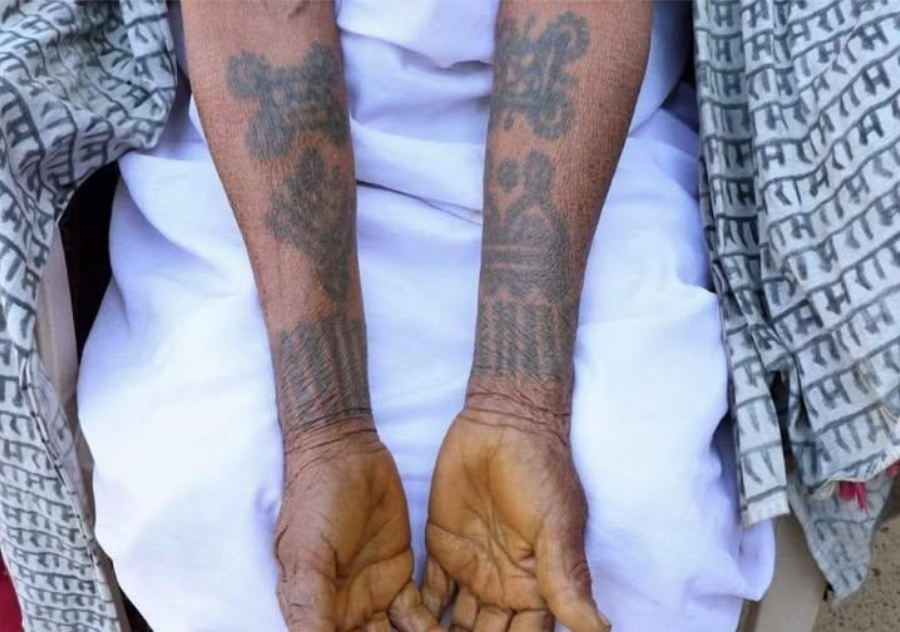
This photo was shared on Virtual Museum of Trinidad and Tobago courtesy of Shalinee Bahadur, showing godna tattoo designs on the arms of an elderly woman of East Indian Descent.
In contrast to the expansive compositions of godna, Pashtun sheen kāl tattoos are notable for their restraint and minimalism. Among Pashtun communities stretching across present-day Afghanistan and Pakistan, sheen kāl (small blue-black tattoos composed of diamonds, crosses, dots, and geometric arrangements) appeared on faces and hands, also primarily on women. Traditionally made with indigo or soot-based pigments, these tattoos frequently appeared as diamonds, four-pointed configurations, small crosses, parallel lines, and clustered dots placed on the chin, cheeks, forehead, wrists, or hands. Their meanings varied from tribe to tribe, but they are very often noted as a modicum of protection against illness, infertility, and the evil eye. Their most popular and defining motif is the dot: a single point or a small arrangement of dots placed on the chin, cheeks, forehead, between the eyebrows, or occasionally near the temples. In some regions these dots were expanded into small diamonds, crosses, or other simple geometric configurations, but elaborate figurative imagery is largely absent. The emphasis lies not in decorative complexity but in the symbolic potency of the mark itself.
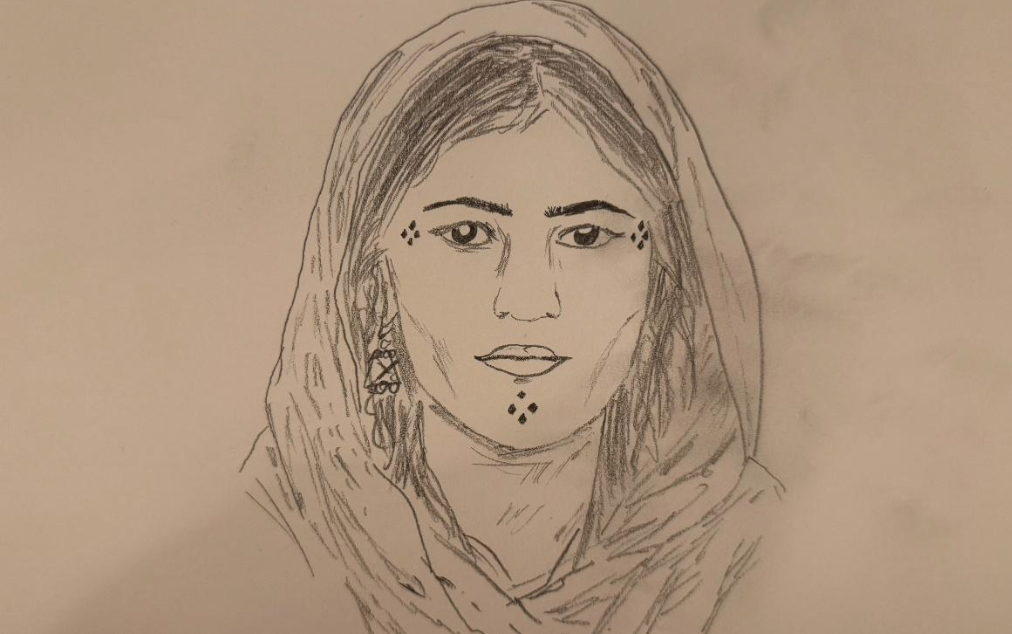
Due to the lack of public domain images of traditional sheen kāl tattoos on Pashtun women, the author has sketched an example of these tattoos on a traditional subject, with markings at the temples and on the chin.
The recurring use of dots and diamond-like formations reflects a broader visual tradition across Central and South Asia in which minimal geometric symbols are believed to deflect harmful gazes without attracting undue attention, allowing the tattoo to function simultaneously as ornament and spiritual safeguard. They do not depict God or spirits. Instead, they interrupt the gaze itself. And this interruption is precisely the point. A malignant gaze cannot easily rest where vision itself is continually redirected. The evil eye is defeated by confusing another’s gaze.
**********
My parents are immigrants from Guyana, descendants of jahajees trafficked from the exit ports of Kolkata. Much like the first jahajees, we don’t have much in the way of ancestral record-keeping. Just ship papers for a great grandfather on my paternal grandmother’s side of the family. Yet this paperwork doesn’t really say much. It was haphazardly filled in by a British officer who was rushing to get my ancestor onto a ship, recording his hometown as Rai Bareilly, his caste as “Musalman,” noting a scar on his left calf, and the name of his next of kin (his mother). An entire life compressed into a handful of bureaucratic entries before being swallowed by grief’s erosion of memory. On my mother’s side of the family, I have even less information than this, just the surname of “Singh” for us to build stories out of with no real ending.
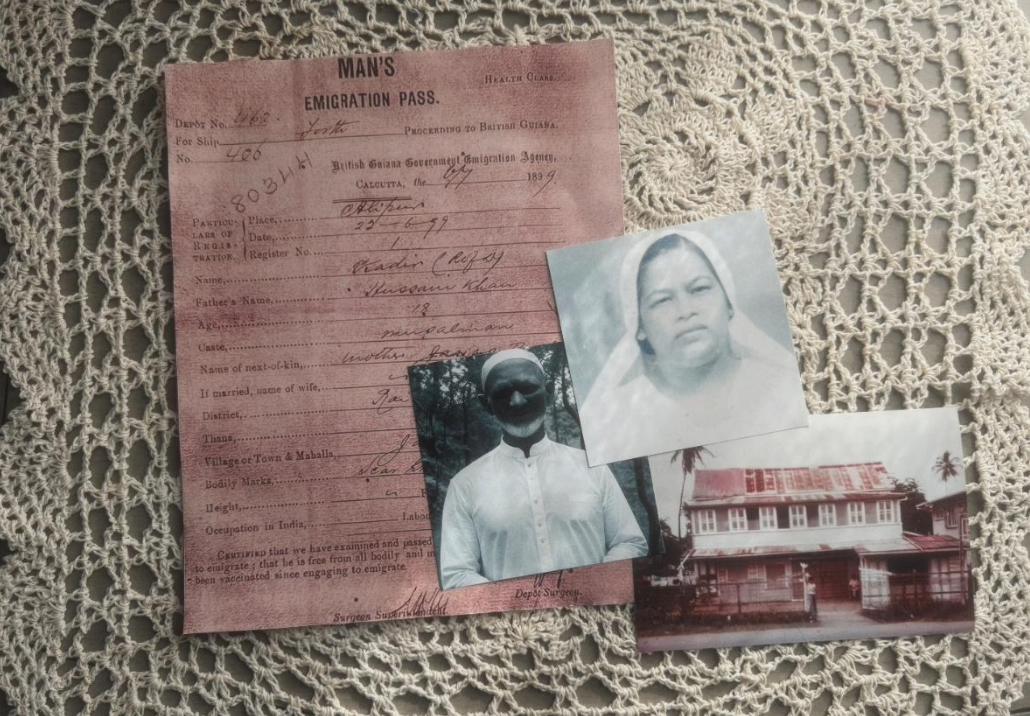
Photo of ship papers and archival family photos provided by the author.
Growing up, however, having the family name of “Khan” as part of my history filled in the gaps created by imperialism. It is a name that traces itself to Pashtun tribes, or at least proximity to them in a time when Islam spread in South Asia. Being of the Khan tribe, then, provided a definitive map in place of directionlessness. It instilled a very passive sense of pride in my family despite the sieves of two migrations that have stripped away even the tiniest inklings of Pashtun identity. We retain nothing recognizably Pashtun: no Pashto, no tribal affiliations, no oral histories stretching back to the mountains of Afghanistan or the frontier of present-day Pakistan. What remains is a surname’s certainty that it once meant something. It is a fragment carried intact through the transformation of a double diaspora; a small but stubborn inheritance that refused to disappear.
When I finally decided to tattoo my own body, I wanted a visual formation that could bridge the godna traditions carried across the kālā pānī by jahajees and the sheen kāl markings once worn by Pashtun women. These tattoo forms share more than a visual language of simple geometric forms. Both emerged from traditions in which the body became an archive of belonging and a site of protection against unseen harm. I chose a sheen kāl tattoo with black diamond shaping because it bridged the ancestry I could document and the ancestry I could only remember through echoes, all by playing with the geometry. And perhaps, if I am being very honest, I chose it because I needed what generations before me believed it could offer: a punch against the evil eye, a small act of defiance against the darkness that, for a time, seemed to gather around my life. If history had left me only fragments, I wanted one fragment I could choose for myself – one that carries memory, protection, and home wherever I go.
**********
The evil eye has no single religion. It predates Islam. It predates Christianity. It predates Hinduism in its post-colonial forms. Across the Mediterranean, the Middle East, Central Asia, South Asia, and much of Africa, people have feared that envy itself possesses force; that another person’s gaze can wilt crops, sicken children, fracture marriages, or invite crushing misfortune. Whether understood as nazar, drishti, or by countless other names, the danger is strikingly consistent across cultures. The remedies are also equally familiar: Blue beads. Black dots. Iron. Smoke. Salt. Sacred verses from the heavens. And, in some instances, tattoos.
Anthropologists have often generally described tattooing as a form of ornamentation or identity expression. Yet among many women who wore these geometric marks, beauty was merely incidental to their primary purpose. The tattoo functioned instead as a permanent amulet. Unlike jewelry, skin cannot be removed. Unlike cloth, it does not wear away. The body itself becomes the talisman.
When nearly half a million Indians were trafficked as indentured laborers between 1838 and 1917, they crossed the kālā pānī under conditions designed to erase identity. Castes dissolved. Families scattered. Ritual specialists disappeared. Cherished geographies became inaccessible. Yet some women arrived already carrying maps on their skin in the form of these inked talismans.
Colonial records occasionally mention tattooed indentured women, usually with the detached curiosity reserved for ethnographic specimens. Old photographs from Trinidad, Guyana, Suriname, and Fiji reveal elderly women whose forearms, hands, and sometimes faces still displayed geometric godna motifs decades after arrival. The scholarship to follow these photographs is despairingly sparse. For that reason, their study is even more essential, and it feels even more significant for me to bear their marks.
**********
As a practicing Muslim I believe in Allah’s word, recorded in the Qur’an through our Prophet (pbuh) whose example is among the most beautiful I have ever learned. The Qur'an cautions us against altering Allah's creation, and I have often reflected on what that means. I do not understand it as a prohibition against change itself, because change is among Allah's greatest signs. Rather, I have come to believe that there are transformations woven into the fabric of our existence; changes that do not reject His creation but fulfill it.
I have never remained the same person for very long. Allah changes me every day, just as He intended. He has changed my mind through knowledge, humbling me each time I learned that certainty was not the same as truth. He has changed my heart through love, expanding it beyond what I believed it could ever hold; through grief, which hollowed out that same hopeful heart; through joy, which filled those empty chambers with light again. Every friendship, every betrayal, every prayer, every unanswered question, every act of forgiveness has left me indisputably altered. My body may have remained recognizably my own all these years, but I have lived many lives within it.
There are ways of changing that require no knife, no needles, and no ink. We change when we surrender our arrogance for compassion. We change when we replace resentment with mercy, when we learn to restrain our tongues, when we become more patient with our parents than we were the year before, more generous with our neighbors, more honest with ourselves. We change each time Allah removes a veil from our eyes and allows us to see another of His signs in the world.
To live is to change. I intend to spend my lifetime changing intentionally, not to change Allah’s creation, but to grow into who He always intended me to be.
**********
The protective designs of godna and sheen kāl extend well beyond tattooing. The diamond appears in embroidered garments from Sindh to Bihar. Similar motifs decorate woven baskets in Fiji, carved doors in Afghanistan, and textiles throughout the Indo-Caribbean diaspora. Whether these similarities result from diffusion, independent invention, or the limited vocabulary of geometric design is less important than the recurring intuition they express: that certain shapes have the power of guarding thresholds, the skin being one of those thresholds.
These formations demand closer study not only as a tattooing practice, but as an archive carried primarily by women. Much of history has preserved the architecture of powerful men: forts, temples, plantations, masjids, churches, courthouses. Women’s histories are more often preserved in textiles, recipes, lullabies, jewelry, and embroidery. But a tattoo cannot be confiscated by a colonial official before sailing to the West Indies. It cannot be pawned during famine. It cannot be divided among heirs. It survives migration with terrifying efficiency.
When an indentured woman stepped onto a ship bound for Demerara or Suva, she may have left behind her language, her village, her ancestors’ graves, and nearly every object she owned. The jahahee and girmitya women did not leave behind their ink.
Today, these tattoo traditions are disappearing. Modern medicine replaced ritual healing. Urbanization altered beauty standards. Religious reform movements in both Hindu and Muslim communities often discourage tattooing altogether, with the latter carrying the heavier restrictions. Younger generations increasingly encounter these marks not on living relatives but in fading photographs. While the evil eye and other dark forces continue to persist, the ancestral practices to shield from them are growing leaner.
It would be historically careless to claim that godna and sheen kāl emerged from a single origin. The available evidence does not support that conclusion. Their practitioners belonged to different linguistic families, different religious traditions, and different historical trajectories. Yet their visual languages often converge in striking ways. The diamond recurs. The repeated dot replicates. And on my body, they reside in a single home. To read godna beside sheen kāl is not to collapse distinct cultures into one another. It is to recognize that people separated by geography often answered the same existential question in remarkably similar ways: How do we make a vulnerable body less vulnerable?
Some answered with prayer. Some with amulets. Some with smoke. And some decided that the safest place to keep a divine weapon was somewhere no empire, no ocean, and no jealous gaze could take it away. They stitched it directly into the skin.
SOURCES
Kloß, Sinah Theres. “Embodying Dependency: Caribbean Godna (Tattoos) as Female Subordination and Resistance.” The Journal of Latin American and Caribbean Anthropology, vol. 27, no. 4, 2022, pp. 601–612.
Mahabir, Kumar. “The Godna or Tattoo Tradition among Indo-Caribbean People.” Caribbean Hindustani, 2020.
Roopnarine, Lomarsh. The Indian Caribbean: Migration and Identity in the Diaspora. University Press of Mississippi, 2018.
Singh, Anjali. Voices and Silences: Narratives of Girmitiyas and Jahajis from Fiji and the Caribbean. Routledge, 2024.
Ahmed, Akbar S. Pukhtun Economy and Society: Traditional Structure and Economic Development in a Tribal Society. Routledge.